Showing posts with label Genealogy. Show all posts

Tuesday, August 24, 2010

How Jewish the Dawson / Eitelman's Are!!!


Believed to Be Jacob Woelfle


Believed to Be Mrs. Jacob Woelfle


Believed to Be Elizabeth Christine Wolfle


Years ago, after I commenced the genealogy, my generation of the Dawson/Eitelman clan would call and asked, "Pete, is it true that Jacob Woelfle was Jewish?"

Jacob Woelfle, recollect, is our ancestor by Bobo...

GF Edward Decatur Eitelman was the son of

G1 GF Michael George Eitelman, who was the son of

G2 GM Elizabeth Christine Wolfle, who was the daughter of

G3 GF Jacob Woelfle, our known Jewish ancestor.


Well, it turns out that we have more Jewish ancestors through Bobo, the Baehr's...

GF Edward Decatur Eitelman was the son of

G1 GF Michael George Eitelman, who was the son of

G2 GF Michael Andrew Eitelman, Jr., the blacksmith in Fort Worth married to Elizabeth Christine Wolfle, who was the son of

G3 GF Michael Andrew Eitelmann, Sr., who came from Germany, who was the son of

G4 GM Elisabetha Bahr.

G4 GM Elisabetha Bahr was clearly the descendant of a Jewish line...

G4 GM Elisabetha Bahr was the daughter of

G5 GF Abraham Baehr, who was the son of

G6 GF Mosche ("Moses") Baehr, who was the son of

G7 GF David "Dov" Baehr, who was the son of

G8 GF Mosche ("Moses") Baehr.


That's a very, very Jewish line of names, and almost certainly Jewish. So, when Michael Andrew Eitelman, Jr. married Elizabeth Christine Wolfle, he was functionally following in the steps of his grandfather Johann Georg Eitelmann, who also "married Jewish."

To me, this was very significant. When I married my wonderful wife Rise Deborah Sobel, I was "marrying Jewish" like G2 GF Michael Andrew Eitelman, Jr., and I have always been so proud of my boys' Jewish/ Catholic heritage.

Now I see that Johann Georg Eitelmann, in Germany, was doing the same.

The Wolfle's, the Baehr's. Who else?

Saturday, July 24, 2010

A Lady of No Reputation Who Was Simply Amazing, Part IX

THE DAWSON'S COME TO AMERICA

In early February, 1851, 20 year old G1 GF WILLIAM SAMUEL CHARLES DAWSON, crushed by the death of his first wife, and sick to death of waiting for employment in London, bade farewell to friends and family in London (perhaps Thomas and Ann Dawson and their son William, also of Christ Church in Spitalfields -- relatives?), and made his way from London to Liverpool. In Liverpool he walked to the docks, and seeing the recently-arrived American-made packet ship "Washington" tied up to the wharf belonging to Taylor, Crooke & Co., the Liverpool agent for the famous Black Star Line, went into the ticket office in front of the wharf and inquired about the price of passage.

"Berths" aboard the Washington ranged from 3 pounds, 15 shillings to 4 pounds for a crate-like "cot" bolted to the deck side of the gunwales, to 5 pounds for a space in a cabin. Any of these fares were enormously more economical than the cost of the trans-oceanic voyage for an individual during the previous century, due to the effects of economies of scale as emigration out of the British Isles increased after the commencement of the Potato Famine. The amount of 4 pounds amount to about 2 weeks' wages for a common laborer during this period. Perhaps WILLIAM chose the mid-range fare of 4 pounds, and then registered. He stated that his name was "William Dawson." He gave his age as "20." He described himself as "a citizen of England" who worked as a "laborer." The clerk for Taylor, Crooke & Co. then gave G1 GF WILLIAM SAMUEL CHARLES DAWSON his ticket for his voyage.

The ticket promised, per day, 3 quarts of water, and, per week, 2-1/2 pounds of bread, 1 pound of flour, 5 pounds of oatmeal, 2 pounds of rice, 2 ounces of tea, 8 ounces of sugar and molasses, vinegar, and 1 pound of boned pork. The reality would turn out to be far less pleasant than the promise.

The "Washington" was built specifically to bus Potato Famine emigrants from the British Isles to America. It was about 200 feet in length, weighed about 1,600 tons in drydock, had a wide beam, and was very sturdily built and easily able to withstand the worst storms the Atlantic could throw at her year round. The ship was commanded by Ship's Master A. Page, while the crew consisted of 4 Ship's Mates, 5 officers including Ship's Doctor Charles Reynolds, and 31 sailors. About 900 passengers were booked to make the passage across the Atlantic with G1 GF WILLIAM SAMUEL CHARLES DAWSON.

On or about February 13, 1851, WILLIAM went to the Taylor, Crooke & Co. wharf and waited in line to board. An English doctor asked him his name, asked him if he felt healthy, told him to stick out his tongue, and then, on seeing his tongue, pronounced WILLIAM "fit."

As the line proceeded across the wharf to the gangplank, WILLIAM was undoubtedly surprised and disturbed to see the Ship's Mates pushing, screaming and cursing to herd the emigrants on board as quickly as possible. He may or may not have realized that this was the beginning of their 6 week effort to jam as many fares as possible onto the boat and get them to America as fast as possible, while giving them as little food and water as possible, to maximize profits.

Once all had boarded, the Washington was untied from its wharf, and perhaps after dropping a sail or two allowed to drift out into the River Mersey, where it dropped anchor.

On the first day of the voyage, while the "Washington" lay at anchor only a few hundred yards from the wharf at Liverpool, passengers were instructed to line-up for water. Only the first 30 to line up received their tin of water. The rest were sent
back to their berths. The same thing happened later in the day -- only the first 30 received their water ration.

Probably sometime during the second day, a steamer approached the
"Washington". The "Washington's" crew threw the steamer a bowline which was tied to a post on the stern of the steamer. Once anchor was weighed, the steamer began towing the "Washington" slowly down the River Mersey. As this was being done, roll was taken on board the "Washington." and stowaways returned to the dock on a small boat.

Once she had been towed to the Irish Sea, where the wind was fresh and reliable, the
"Washington" cut loose from the steamer and unfurled its sails.

A week passed. Still, nothing but water had been doled-out to hungry passengers. Finally, Ship's Doctor Reynolds was seen moving from berth to berth, taking note of passengers less than 16 years of age. Though the Black Star Line contract, and naval regulations, permitted half rations only for those who were less than 14 years of age, Captain Page arbitrarily raised that limit to 16. Perhaps he felt that he had a right to to "handicap" to protect against lying by passengers -- assuming, of course, that no food at all during the first week was legitimate.

More days passed with no food being distrubuted. When whipping, cursing, punching and screanming failed to quell the riot for food, food was finally distributed. Some passengers who noticed that the Ship's Cook was very generous to passengers who bribed him with money or whiskey complained, but to no avail. Ultimately, passengers received less than one-half of the provisions promised by their contract.

Fierce and frigid Winter storms slammed against the vessel during the ensuing weeks. When the weather became too rough, sails were reefed-in to protect against capsizing, while gigantic waves of freezing water came crashing over the gunwales into the "berths." Many passengers prayed during such storms. Those who died of the diseases brought with them from Liverpool -- cholera, typhoid, and dyssentery -- were tied-up in cloth bags weighed-down with rocks and tossed overboard.

On March 28, 1851, after Ship's Master Page never once showed his face to the passengers, Doctor Reynolds began walking down the deck between berths, screaming, "Now, then, clean-out and wash-out yours rooms, every one of you, God damn and blast your souls to Hell!" The passengers were greatly cheered by this, realizing as they did that clean-up time meant that they were nearing the American coast, and would soon be able to disembark from their Hell-hole. A short time later, G1 GF WILLIAM SAMUEL CHARLES DAWSON and the other passengers saw with their eyes what Captain Page had seen through his telescope -- the American coast.

Finally, on March 31, 1851, the "Washington" sailed into New York harbor. Passengers crowding against the gunwales stared wide-eyed at the Statue of Liberty, correct? Not at all. It did not even exist in 1851. Then, later the same day, sick passengers were ferried ashore to quarantine on Staten Island. The balance of the passengers stayed on the Washington until it tied-up to the wharf at Ellis Island, a tiny tract of land in New York harbor, then about one-eighth its current size, closer to the Jersey shore than to Manhattan, featuring only a few small wooden buildings. There G1 GF WILLIAM SAMUEL CHARLES DAWSON disembarked with the remaining passengers, was given a brief physical, and waited, until a ferry from New York City arrived to take them ashore. On that day WILLIAM SAMUEL CHARLES DAWSON swore allegiance to the United States of America, and he became an American citizen.

A Lady of No Reputation Who Was Simply Amazing, Part VIII

Dore's Portrait of East End Squalor

Wash Day in the East End


Christ Church, in Spitalfields, London, the Anglican Church

Where William Samuel Charles Dawson Was Baptized


Street Urchins in 19th Century London


LONDON ROOTS OF THE DAWSON'S

During most of the first half of the 19th century, while English overlords in London's West End collected rents from their stolen Irish estates, and demolished Irish industry by flooding Ireland with cheap English manufactures after the Act of Union indirectly eliminated all trade barriers, London's neighborhoods for the working classes in the East End boomed as employment opportunities in London's newly-mechanized factories grew in number. The new neighborhoods lacked sewage facilities -- toilet and wash water drained into the Thames from open gullies in the streets. Public transportation was just then coming into its own, so that steam locomotives at street level or on elevated tracks belched steam, oil, sparks and smoke into adjacent streets. In short order new neighborhoods became overcrowded working-class ghettoes. Cholera, typhus and dyssentery spread via the open sewers. Mini-epidemics of these diseases, wiping out this section and that neighborhood of London's East End, became commonplace. Especially during the Summer, the smell in London began to become so unbearable that Parliament actually considered leaving for a pleasanter location.

Around 1810, somewhere in these interesting neighborhoods in London's East End, a little boy name WILLIAM DAWSON was born to one working-class family, and a little girl named SARAH TRAVELLER was born to another working class family. These would become our G2 GPs, the parents of G1 GF WILLIAM SAMUEL CHARLES DAWSON.

Both G2 GF WILLIAM DAWSON and G2 GM SARAH TRAVELLER would have been baptized into the Church of England by their parents.

The London of the first half of the 19th century is well-portrayed in Dickens' novels. On the East End, it really was a despicable place. Both G2 GF WILLIAM DAWSON and G2 GM SARAH TRAVELLER would have "lived lives of quiet desperation" in their families, going out to work, without much education, if any, as early in their teen years as possible to supplement family income. There is some evidence that they met and engaged in an intimate relationship before marriage, and that G1 GF WILLIAM SAMUEL CHARLES DAWSON was conceived and born before their marriage, a not-uncommon thing in the disorganized lives of the denizens of the East End in those days, according to books on the subject.

G1 GF WILLIAM SAMUEL CHARLES DAWSON's early years would not have been much different from that of his parents. As a member of the working class in London's dirty East End, he would have been poorly educated, and forced out to work as early as possible in his teen years. WILLIAM SAMUEL CHARLES DAWSON's classsification, on his immigration record, as a mere "laborer" bears this out. Who knows when his parents died, and why. Perhaps one of the many cholera, typhoid or dyssentery epidemics, borne through London by the sewers, did them in.

It was customary for young men in London's East End to commit themselves to marriage at around the age of 17 or 18. G1 GF WILLIAM SAMUEL CHARLES DAWSON apparently did so, probably around 1848. We really know nothing at all about his wife, except that, according to family tradition, she died shortly after their marriage, perhaps of one of the mini-epidemics of cholera, typhoid or dyssentery which came out of London's open sewers on a regular basis, or perhaps she was one of the 250,000 victims of the great tuberculosis epidemic which assailed the population of London and its suburbs between 1850 and 1855.

While 1848 was a deadly year in Ireland, 1848 and subsequent years were difficult years in London's East End. When the Potato Famine hit Ireland, the Irish suddenly had nothing, so that English exports to Ireland plummeted. Elsewhere throughout Europe, the failure of the potato crops due to the same fungus caused food prices, generally, to rise, resulting in a massive shift of cash from industry into farming, further drying-up markets for England's manufactures. Suddenly, the working class in London's East End, and throughout Europe, were thrown out of work. Unemployment as a consequence of the failure of the potato famine is the major caused of the violent revolutions wracking government across Western Europe in 1848.

The employment picture would not have been too pretty for G1 GF WILLIAM SAMUEL CHARLES DAWSON during this period. Though London avoided a revolution in 1848, emigration to America of the chronically unemployed began to skyrocket. Hundreds of thousands of English young people began to join the Irish crammed into the windjammers out of Liverpool, hoping for a better life in America. WILLIAM SAMUEL CHARLES DAWSON was one of these.

A Lady of No Reputation Who Was Simply Amazing, Part VII

Eviction day: After Parliament "taxed the problem to eliminate it,"
by adopting thge Four Pound Clause -- a $3,000 annual penalty on every
quarter acre set up for potato cultivation -- English landlords evicted every
Irish family, previously forced by them into n potato farmjing,
from every potato plot to avoid the penalty; 4,000,000 Irish Catholics
were suddenly homeless; 1,500,000 died in Ireland;
250,000 died on the ships to America


In drawings from the era, the men are frequently absent;
they died giving up their food to the women and children,
or charging the docks, crammed with food being exported by Engliush landlords,
in the famous "skeleton armies"


Relief measures were only sufficient to help about one-fifth of the evicted, starving Catholic families. The rest walked until they died of starvation. The Roman Catholic Church was illegal. Therefore, only the Protestant churches could publicly maintain active soup kitchens. Some of these required conversion to Protestantism before food was provided -- the famous "soupers." Many starving parents had to decide whether to bury the first of their children to die, or butcher and cook the dead to feed their living children. While the bellies of the young swelled enormously in response to the complete absence of food, dogs left behind by their dead masters formed packs and began unearthing famine victims from shallow graves, so that their bellies became swollen with human flesh. The image of the leprachaun with swollen belly, skinny limbs, and thin, curly facial hair which we see in today's cartoons dates from this period -- that is what an Irish boy looked like shortly before death from starvation, down to whispy, prematurely-sprouting facial hair.

As pregnant ANNA and her husband slowly starved, since they apparently lived in Londonderry County they functionally starved in front of their Protestant neighbors. The experience must have very, very drastically impacted their outlook. Though he is completely unrelated to us, ANNA's first husband Mr. Mallon should probably be remembered as someone who gave his life for our G1 GM. He died; pregnant ANNA didn't.

At a particular point ANNA gave birth. How she must have agonized when she realized that her baby, great aunt BARBARA MALLON, was blind! Perhaps ANNA ultimately received some assistance from one of the poorhouses erected after the beginning of the famine. At a particular point, ANNA decided to join the millions of Catholic Irish who were emigrating to America to survive. A tiny amount of indirect evidence suggests that ANNA made application for funds from one of the several English philanthropists who were paying for passage to America.

Probably around the year 1848, G1 GM ANNA FULLER, only about 19 years of age, holding the tiny hand of her blind little daughter, great aunt BARBARA MALLON, boarded one of the steamers out of Londonderry carrying emigrants to Liverpool. "At last," she may have thought, "I will escape hardship and find an easier life in America." And she did -- kind of.

The great packet ships built to carry people from the British Isles to America had not yet come into their own. Early-on in the Potato Famine years most passengers were carried in windjammers originally built to carry cargo across the Atlantic, but converted to move people.

The voyage across the Atlantic took about six weeks. I will tell the story of such a voyage in the narrative on G1 GF WILLIAM SAMUEL CHARLES DAWSON, since it is so well documented in his case.

It is more likely than not that g1 gm ANNA FULLER and her little daughter BARBARA MALLON came to the United States through Canada, and that therefore their point of disembarkation was Grosse Isle in the St. Lawrence Seaway, about 30 miles east of the city of Quebec (not the Grosse Isle out in the Atlantic). Grosse Isle, one of Canada's most important quaratine sites, was a horrible place. Many thousands of Irish who emigrated during the famine years died there of typhoid, cholera and dyssentery, if they survived the voyage across the Atlantic. Though the British government hoped that many of the Irish disembarking at Grosse Isle would stay in Canada, in fact the overwhelming number of those who survived quarantine either had themselves ferried up the St. Lawrence Seaway if they had money, or ferried to shore if they didn't so that they could walk south to the United States.

Somehow, ANNA moved south into the United States with her little daughter, all of the way to Philadelphia, so that in 1851 ANNA was living at #3 Goldsmith Court in Philadelphia, as described in the 1852 Philadelphia Directory (which explains in its introductory passages that it is published in the beginning of 1852, using the very latest 1851 information). Why Philadelphia? The answer may have been the famous Pennsylvania Institution for the Instruction of the Blind, at 20th and Race Streets in Philadelphia. An oral tradition of the family hints that ANNA may have had her daughter BARBARA MALLON boarded there.

Not too long after her arrival in Philadelphia G1 GM ANNA FULLER met and married her second husband, our ancestor G1 GF WILLIAM SAMUEL CHARLES DAWSON, whose story we shall now commence.


TO BE CONTINUED

Tuesday, July 20, 2010

A Lady of No Reputation Who Was Simply Amazing, Part V

After the bloody 17th century, the antagonism of the Catholic Irish toward English Protestantism was way too deeply imbued to be erased. The Irish social order was collapsed by the English, but there was a new psychology in its place -- far more defensive, far stronger than anything ever confronted by the English. Cromwell, in committing genocide, and the subsequent invasion by the English in the Williamite War, left the Irish culture with a very permanent bad taste in its mouth.

As the 18th century progressed, English overlords, ruling their stolen lands, forced the Irish to grow crops for export only.

At the same time, the price of those crops was driven down slightly by imposing large tariffs on Irish exports to England, while exempting English goods exported to Ireland from tariffs, milking Ireland's economy, but badly injuring Irish welfare in the process.

As this process continued, Irish anger began to build. Extremely cold winters generating a food shortage in 1740 and 1741 was made ten times worse by the English economic policy. 400,000 Irish -- about one-eighth of the population, died.

The oppression of Irish grew so fierce that Protestant Irish and Norman Irish united with some Catholics to form the Society of United Irishmen to pressure the English into permitting Irish self-rule. When it became clear that the English were determined to only exploit the Irish, anger exploded into Wolfe Tone's Irish Rebellion of 1798.

Wolfe Tone induced the French to try to land a very large army in Ireland in 1796, but severe storms made the landing impossible and the soldiers were returned to France. Accompanying acts of sabotage by Irish rebels shocked the English into terrorizing the Irish with mass burnings, torture and murder of both Catholic and Protestant Irish. Comprehending the impact of indiscriminate torture and murder -- a much more united Ireland -- the British military recommended manipulating Irish Protestants with reports that the British government was only suppressing a "popish" conspiracy. The documents verifying this are very clear.

As the British noose tightened, alarmed Ireland exploded.

Armed guerilla units attacked British army units and forts from all sides. England poured thousands of troops into Ireland. By-and-large, the trained British, assisted by native loyalists, carried the day. Catholic and Protestant rebels were relentlessly pursued. There was little taking of prisoners by the British. Captives, healthy and injured, were tortured and murdered. Their families were raped, tortured and murdered.

The rebels struck back with localized terror, but there was no comparison with British terror.

The French landed a small force of 1,000 regulars accompanied by Wolfe Tone. 5,000 rebels joined them. At Castlebar the British retreated in panic, suffering an embarrassing defeat. Ultimately, the British prevailed, capturing the French and rebels. French prisoners were traded for British prisoners. Irish rebels were murdered.

By the end of 1798 the rebellion had lost its steam. The last of the rebels' guerilla groups did not surrender until 1804, however.

Afterwards, the British used the divide-and-conquer method in Ireland, favoring Irish Protestants while terribly oppressing Irish Catholics. Catholicism was essentially outlawed. Agriculture was "reformed," as four-fifths of the Irish Catholics were forced into potato cultivation, recently discovered by British landlords in London's West End as a means of maximizing profits, setting the stage for the greatest catastrophe of all.

Next chapter: Annie's story.

Sunday, April 18, 2010

GGGGGGGG GF Garrett Van Swearingen, Part II

There are portraits of Garrett Van Swearingen and of Barbara DeBarrette Swearingen, available online and picture here. Since Barbara DeBarette died when she was 34, probably in childbirth, then both Garrett and Barbara were 34 years of age of younger in those portraits.


Garrett looks a li-i-i-i-ittle bit older than 34 in his portrait.


But Barbara's portrait is another story. Let me be PERFECTLY frank: She look's like somebody's aging mother, in the portrait!


What happened to them, after their 1659 marriage in Fort Casimir, is probably the best explanation.


Perhaps because the French and Indian War was raging around them, the Dutch were extremely sensitive to the need toi treat the Algonquians tribes around them with carefully-administered justice.


So, on March 1, 1660, Garrett Van Swearingen was appointed to very carefully judge a case involving the murder of an Indian, probably by a Dutchman.


At around the same time, something else was happening in New Amstel which might or might not have been connected to the case of the dead Algonquian.


Very early in 1660, a Dutchman named Jan Gerritsen van Marcken traveled from Stuyvesant's New Amsterdam to collect a debt from one of the people living in or around New Amstel.


With the approval of d’Hinoyossa, President of New Amstel, Garrett Van Swearingen, as "Schout," or Sheriff, of New Amstel, arrested van Marcken, and charged him with an impressive list of criminal violations. Van Marcken was convicted of "just about everything in the book."


On June 7, 1660, Stuyvesant, the overall Governor, reversed the judgment, and ordered Garrett Van Swearingen to pay costs of suit and damages for False Arrest!


A chronicler of the era tells us....


"On August 30, 1660 Garrit van Sweringen and his wife sailed for Amsterdam without obtaining a passport from Stuyvesant. He took with him 31 skins, which he declared, and another 100 skins that he did not declare. He had bribed the supercargo of the ship. In Amsterdam he used the extra 100 skins to bribe the Directors of the West Indies Company."


Lo and behold, "On December 24, 1660, the directors of the Dutch West Indies Company sent Stuyvesant a letter chastising him for overruling Garrit van Sweringen’s case against Jan Gerritsen van Marcken, saying it was politically unwise for him to interfere with the affairs of the City of Amsterdam’s colony at New Amstel."


Was it just a case of "bribery"?


The French and Indian War was a political powder keg. The English, who hated the Dutch, would have loved a pretext for turning the Algonquians upon the Dutch, to accomplish their murder for them.


In light of such considerations, the words to Stuyvesant -- that "it was politically unwise for him to interfere with the affairs of the City of Amsterdam’s colony at New Amstel" -- have a special significance.


The lives of every citizen of New Amstel may have been "in the sling."


I think that, under the circumstances, we should judge Garrett Van Swearingen with special charity, here.


One genealogist says that Garrett and Barbara's first child, Elizabeth, was born to them in 1661. If she was, she was either born in Holland or on board the ship ‘Purmerlander Kerck’ which sailed for America in November, 1661, arriving on February 3, 1662.


While Barbara was pregnant with their second child Zacharia, or shortly after Zachariah's birth, in 1662, something terrible happened. Garrett Van Swearingen murdered a Dutch soldier.


"On the evening of June 20, 1662 three of Stuyvesant’s soldiers were in New Amstel enjoying drinks at Fop Johnson Outhout’s Inn. They went out for a stroll and were having a great time singing. Their path took them near Garrit van Sweringen’s home. He took exception to their singing and after a few shouts fired on the soldiers. His shot killed Hermen Hendricksen van Deventer.


"Stuyvesant’s South River (the Delaware River) deputy, Willem Beeckman, was furious and collected affidavits and interrogatories from witnesses that he forwarded to Stuyvesant. The affidavits and interrogatories were taken in the home of Johan Andersson Stalcop. Perhaps it was considered as the nearest neutral site.


"The Governor of the Colony of the City, d’Hinoyossa, did nothing about it other than temporarily suspending van Sweringen as schout. Stuyvesant felt helpless to do anything about it. He wrote to Amsterdam that he thought the burgomasters of the City of Amsterdam should hear the case.


"Van Sweringen was never tried. Instead his superiors in Amsterdam decided the killing had been done in 'self-defense.' The soldiers were completely unarmed. Garrit van Sweringen was officially pardoned."


On May 1, 1663, Garrett Van Swearingen was reinstated as Fort Sheriff.


In 1664, the world turned upside-down for the Dutch and for Garrett and Barbara Van Swearingen and their family. Relationships with the local Indians finally exploded, and Van Swearingen was dispatched to patrol the vicinity and kill Indians. One chronicler wrote, "He had fought the Mohegan Indians in the forest beyond Beverwych, driving the war bands before him, consuming their villages until the savages begged for mercy. His days went by with battle and nights with watchfullness. Van Sweringen and his company came down from the hills through the forest of Beverwych, to find the city of New Amsterdam had been taken by the English."


Thje English, it turned out, had invested New Amstel and simply stolen it from the Dutch while Van Swearingen was off fighting Indians in the French and Indian War. Here is the Chronicler's full account, including Lord Baltimore's miraculous offer to Garrett and his wife and children...


"Colonel Nicols of England, sent by His Majesty, Charles II, and his deputy Sir Robert Carr were to take over the Dutch colony at New Amstel

"Van Sweringen said wearily, 'Without a blow they took Amsterdam, as if there were no one near.' Then drawing his sword from the scabbard, he kissed its long, straight, splendid blade, and, with sudden of anguish, broke it across his knee, and standing as high as he could in his stirrups he threw the pieces over the wall into the dusty meadow grass. 'Farewell good blade, forever more!, he said, 'forged in honor, honorably brave, shall never be drawn in dishonor. Thou wast wrought to strike for the Netherlands, and thou mayst not strike for the Netherlands. Thy steel was for the Netherlands, my hands are for van Sweringen.' Then he stretched his hands out before him, saying in a piteous, chocking voice, "They are all that is left, I am ruined!' For at first he was thinking of himself, but now he thought of his wife and daughter. He rode through the gate to the house where his wife and daughter were staying, he went quickly. His wife was sitting at the window. 'Barbarah,' he said, 'I am ruined!' and there he stopped, he was chocking. She looked up quietly, 'Yes Garrett,' she said, 'I heard of it. They can not say that I married thee for thy money anymore,' and with that she laughed very softly. Garrett said , 'I have not a guilder to my name, I am brought to beggary.' Barbarah said, 'I am just as rich as thee, dear heart, as ever I was. To be ruined without fault is no disgrace.' She said, 'it matters not to me for I gave up home and everything to go with thee.' His wife was sitting on one side, Elizabeth, his daughter, on the other, sitting upon a foot stool and leaning against his knee. 'Father,' said Elizabeth, 'We don't mind it terrible for us. We shall take a little house, and mother shall do the weaving, and I shall do darning and spin, oh how I can spin, and I shall gather wild hops for the brew, and nuts and berries in the woods. We woman will cook, and thee shall work by the day, and we shall save stuiner by stuirer untill the stockings are full again.'

"About this time there was knock at the door, it was Lord Calvert. Needless to say Garrett van was in no mood for English humor, which he misunderstood. The governor actually came to offer Garrett a position of sheriff in Maryland. 'There are pretty posies hanging their heads in rows for the lass to come and pick. Carr is a dirty scoundrel, I have just told him so to his thieving face.' said Master Calvert. 'Let me make good the wrongs he has done. Then ye shall need no more to curse the English for a pack of thieves and perjurers. Come down to Maryland, van Sweringen, you and all that be yours. Man it will be a happy day! Mistress van Sweringen,' he said, with a laugh and half a choke, 'Prevail with me against this dear, honest fool of thine. He is the most obstinate , argumentative person that I ever stood against. Lord Bal timore had told him you can take up 1,000 acres, at twenty shelling a year. Ye may believe as you please and say what you will, so you be Christian and speak no treasons, and if you will teach us to keep our own lawns as you have kept of the Dutch, you will confer a precious favor on the next Lord Baltimore.' As his long speech ended, he silently bowed, and stood there quietly. Meinheir van Sweringen got up from his seat turning said simply, 'My friend, my good and true friend, I thank you from the bottom of my heart, you have put a new light in the world for me.'

"Van Swearingen later testified, ‘Sir Robert Carr did often protest to me, that he did not come as an enemy, but as a friend; demanding, only in friendship, what was the King's own, in that country. There was taken from the City and the inhabitants thereabout, to the value, so near as I can now remember, of four thousand pound sterling, likewise arms, powder and shot in great quantity. Four and twenty guns were, the greatest part, transported to New York.


"The Dutch soldiers were taken prisoners, and given to the merchantmen that were there, in recompense of their services; and into Virginia, they were transported to be sold, as was credibly reported by Sir Robert Carr's officers, and other persons there living in the town.


"All sorts of tools for handicraftsman, and all plough gear, and other things to cultivate the ground, which were in great quantity; besides the estate of Governor Debouissa and myself; except some household stuff and a negro I got away; and some other movables, Sir Robert Carr did permit me to sell.'"


And so, in 1664, our GGGGGGGG GP Garrett Van Swearingen and and Barbara DeBarette Swearingen and their children and Barbara's father and brother moved to St. Mary's County, in southern Maryland, and began a new life there.


Who can blame Barbara DeBarrette for looking 20 to 30 years older than her husband?


More to come.

GGGGGGGG GF Garrett Van Swearingen

Great great great great great great great great ("G8") grandfather Garrett Van Swearingen, a Dutchman, really is one of our more intriguing ancestors.


He is our mother Eleanore Anne Eitelman's (and therefore Uncle Eddie's and Uncle Mike's)...


father Edward Decatur Eitelman's
mother May Katherine Pitman's
father Decatur Pitman's
mother Eleanore Amanda William's
father Congressman Jared William's
mother Anne Swearingen's
father John Swearingen's
father Thomas Swearingen's


father.


Garrett was born to David Janse Swieringh and Hester Jacobs in Beemsterdam, Holland on February 4, 1636. (A few sources say "Reemstwerdam," but this is almost certainly a typo copied from one fastidious chronicle writer by another. Beemster is a section of Noord Holland County. "Beemsterdam" or "Beemsterwaal" refers to the section of Beemster closer to the inland sea, next to the dike. It is possible that "Reemstwerdam" is a reference to "Amsterdam" a short distance to the south, but I find no geographical precedent for the "ee" instead of "a" between the "r" and the "m" of "Ramsterdam.")


In the 1500s, the Netherlands, especially the Holland counties on the west, were a hotbed of economic and religious and political rebellion. The Holland counties became the most densely-urbanized section of all of Europe in the 1500s, and generally well-to-do. However, as the nation-state concept gained preeminence in the thinking of the people, increasing awareness of the idea of Separation of Church and State, as it did in Germany, and as the Princes of the Church in Europe wenched and taxed their way to disgust and infamy, the people of Holland started getting "itchy." After Holy Roman Emperor Charles V began to back-off Inquisition-style repression and executions in the Netherlands -- and there were a lot of executions in the Netherlands -- and began to grow lax in tax collections, his son Phillip II, inheriting the Netherlands as his share of the Holy Roman Empire, tightened the Catholic noose while reaching into purses with renewed vigor.


This made the Netherlanders, both those known to be sympathetic to Herr Luther and those who remained loyal to the Church, crazy people. The Protestant AND Catholic nobles asked for relief, and Margaret of Perma, Regent in Phillip's absence, was very intimidated by the unanimity of the support for relief, and, being small-minded, responded in exactly the wrong way, at a pivotal moment in history: She called the nobles "gueux," "beggars," and kicked them out of the room!


And thus began the Eighty Years War, one of the Reformation Wars which devastated Europe, in 1568.


Street gatherings led to armed mobs led to an attack on the walled town of Veurne. Called to respond, the militias -- the "Dutch National Guard" -- declined to repress the attack. Regent Margaret made late concessions to try to quell resistance. But she was closing the barn door after the animals escaped. Resistance continued. A noble loyal to Phillip led an army against the disorganized Calvanist rebels, crushed the revolt, and executed all of the leaders.


Phillip, alarmed at all of this, sent the Duke of Alba and a large army of Italian mercenaries to Holland. Alba proceeded like a political moron. He arrested 9,000 Hollanders, Catholic and Protestant, and executed 1,000 of them, and drove the rest into exile, seizing their property.


"Sea Beggars" -- Calvanist pirates authorized by Letters of Marque from William of Orange as Count of Holland, with a name snidely referring to Regent Margaret's unkind words dismissing the nobles of Holland -- preyed on Holy Roman Empire trade.


William of Orange invaded the Netherlands at the head of an army of 30,000 Germans, mostly Protestant. but he began to run out of money, and therefore began to lose his ability to feed his soldiers, who began to melt away.


But Islam, of all things, came to the rescue. Phillip was too distracted by the ferocious war with Turkish Islam at the Battle of Lepanto to oppose even William's weakened army.


And then the Duke of Alba was doubly stupid. He frightened even his most ultra-loyal ultra-Catholic supporters in the Netherlands with his brutal tax collections, and destroyed all local support.


The Dutch, Catholic and Protestant, suddenly wanted independence.


William of Orange proved himself even more harebrained than Alba, when he joined an invasion of the Netherlands, to promote respect for unity and public order in France!


At the same time, as all pirates do, William's Sea Beggars got out of hand, and began to prey upon 100% Catholic-but-neutral Hanseatic League ships, profitable to all.


Two negatives multiplied-out to a positive, here, though. Alba withdrew his Catholic army from a port named Brill to oppose Orange. The Calvanist pirates of William, having disgusted Queen Elizabeth by their profit-threatening anti-Hanseatic activity, were met with fierce opposition at sea. They took refuge at Brill. The pro-rebel militia in Flushing seized their port and invited the Sea Beggars there, too. William sought the support of these two ports and the surrounding provinces, and got it. Suddenly, he had his own united Catholic/Protestant rebel kingdom!


For the next 60 years, the battle went back-and-forth, back-and-forth. In all of the chaos, by 1635 the relatively-religiously-neutral Dutch had generated a stable, habitable republic which saw its way to entering into a Treaty of Alliance with Catholic France to divide-up the Spanish Netherlands, generating more warfare.


During this time, the Dutch East India Company and Dutch West India Company began to become extremely prosperous, generating a navy larger than that of any other in the world.


William of Orange's rebellious little state had become a world power.


This was the context of Garrett Van Swearingen's birth. At least one of his parents -- we can't tell which -- had him baptized Roman Catholic, and he remained Catholic to the end of his days. His Catholic faith, which he tended to "wear on his sleeve," makes his biography all the more notable, in several ways. We will see that, despite his Catholicism, he was at all points implicitly trusted by the Dutch West India Company. Despite his Catholicism, he will win a fierce political battle over the fate of a murderous debt collector visiting a colony for which Van Swearingen was sheriff and a judge. Despite his Catholicism, Van Swearingen will literally get away with murder, himself. Finally, despite his Catholicism, the English, in an attack upon Swearingen's little American colony, let him live, and probably because of his Catholicism Lord Baltimore gave Van Swearingen a wonderful tract of land in Maryland.


One biographer credits Garrett Van Swearingen with being well-educated, based on his knowledge of French, German and English. One gets the sense, in viewing his life panoramically, that he was indeed deeply intelligent. But in fact his knowledge of the three languages may simply be the result of his roots and exposure to cosmopolitan Holland.


Probably after several years' exposure to the shipping industry in Holland as a teenager, in December, 1656, at age 20, Garrett Van Swearingen secured employment as "super cargo" -- superintendent of cargo -- on board the Dutch West India Company's "Prince Maurice." His subsequent actions, bold, tending to take control in a responsible fashion, ratify the wisdom of his appointment, and verify a supposition that even at age 20 Garrett Van Swearingen had considerable experience even at age 20.


West India Company archives related the following...


"Sailed from Amsterdam December 21, 1656, left Texel December 25, 1656, arrived at Long Island March 8, 1657; wrecked.


"Jacob Alrichs, director
Alexander D'Hinoyossa, Lieutenant
Evert Pietersen, comforter of the sick
Gerrit van Schweringen, Supercargo
Jan Barents, chief boatswain
Jan Gerritsen, sailor
Joost Theunissen, sailor
129 persons including Colonists, free mechanics, soldiers and attendants.

"J. Alrich reports: 'We proceeded with them on the proposed voyage, and after some storm and other obstacles, reached the vicinity of the Manhattans. ...[T]hrough ignorance of the skipper and pilot who were never on this coast, having neared the shore in the evening, [the Prince Maurice, on March 8, 1657] immediately grounded, and so shoved, which continued afterwards harder and harder, that we were not for a moment, sure of our lives, and seeing no escape in the morning, we unanimously resolved to save ourslves on a broken coast, which we, some days later, understood to be Long Island. An agreement was made with the skipper of the Beaver to charter the passengers to the Colony on the South River. The Beaver set sail from New Amsterdam on April 16 to the South River, arriving at New Amstel, April 25th, with about 125 persons for the Colonie from the ship Prince Maurice, including 50 persons who arrived on other ships. Thirty-eight soldiers, with the Captain and Lieutenant, marched over land because there was no room in the Beaver to allow of their coming by water. The ship experiencing contrary wind, the soldiers, on that account, started somewhat later from the Manhattans, and therefore arrived at the fort six days later."


Other details which have come down to us are that Dutch Governor Peter Stuyvesant, hearing from some Indians that a vessel had run aground on some rocks just outside Fire Island Inlet, sent a small boat to investigate; that Garrett Van Swearingen was carried by that boat to Peter Stuyvesant and introduced to him, and that Peter Stuyvesant, after receiving a full report from Van Swearingen, released him to allow Van Swearingen to hire a somewhat smaller boat, the "Beaver," to ferry "Prince Maurice" passengers and crew ashore and off-load the valuable cargo.


New Amstel, their ultimate destination, was Fort Casimir, now Newcastle, Delaware on the South River, now Delaware River.


Fort Casimir was no impregnable fortress. A sketch and a model illustrating that it was little more than a small walled compound containing the fort's residential headquarters make it clear that it was a place Dutch colonists would only retreat to in the event of an emergency...


On April 25, 1657, Garrett Van Swearingen, his superiors, the colonists and the soldiers demanded surrender of Fort Casimir by the occupying Swedes. The Swedes duly surrendered the fort, without violence, perhaps because the Dutch comprised a vastly superior force. The Dutch renamed the fort New Amstel.


Garrett Van Swearingen rose up steadily through the ranks, from Clerk in the Fort Store, to Chief Commissary, to Second Councilor, to First Councilor (Executive Officer), to Captain -- the military commander-in-chief -- and "Schout" or Sheriff, and judge


In January, 1659 (the most-commonly-cited date), GGGGGGGG GF Garrett Van Swearingen, at 23 years of age, married GGGGGGGG GM Barbara DeBarette, also 23 years of age, daughter of GGGGGGGGG GF Isaack DeBarette, probably a wool merchant from Valenciennes, Nord Pas de Calais, France, who brought Barbara and her brother Peter to Fort Casimir, perhaps at Garrett Van Swearingen's invitation.


In December, 1659, Garrett Van Swearingen reported by letter to a sponsor in the Dutch West India Company...


'New Amstel, December 8, 1659

'NOBLE, WORSHIPFUL, WISE, RIGH, PRUDENT SIR: --


'With due respect and reverence, have I hereby taken the liberty to greet you, though bound in duty of gratitude, to devote to you all the days of my life. ...I cannot neglect, hereby to communicate my promotion. About a year and a half, after my departure from Patria (my native country), with your Honor's faborable recommendation, I have been appointed Sheriff here subject to the approbation of the Honorables the Principals. Previously, I have taken care of the store as clerk; and after J. Rynevelt's death, as Commissary, from which I have not requested to be discharged, as I have, though unworthy, been recently made Second Councilor, with Sir Alexander Hinojossa, First Councilor, and Captain of the military here, who intends to go over in the Spring, to represent this miserable place.


'If things become worse, I, individually, am ruined, for I have received here, some goods from my brothers, all of which I have laid out in a house, horses and mules, which cost me full, four to six thousand guilders, Holland currency.


'Besides that, I am also married. ...


'Herewith I commend your Honor to the mercy and protection of the Most High God, and remain.


'Your obedient, humble servant,


'G. Van Sweringen'


More to come.


Thursday, February 25, 2010

How the Dawson's and Eitelman's Are Cousins of Marilyn Monroe!

Yep, she's a cuz. Technically, Marilyn is in our parents' generation. She is our parents' 9th cousin, and so she is our 9th cousin 1ce removed, and our kids' 9th cousin 2ce removed. Here's the lineage...

Marilyn Monroe was the daughter of
Charles Stanley Gifford who was the son of
Frederick Gifford who was the son of
Charles Gifford who was the son of
Lydia Tompkins who was the daughter of
Uriah Tompkins who was the son of
Micah Tompkins who was the son of
Sarah Coe who was the daughter of
Sarah Pabodie who was the daughter of
Elizabeth Alden who was the daughter of John and Priscilla Alden, Pilgrims on the Mayflower.

John and Priscilla Alden also gave birth to
David Alden, brother to Elizabeth Alden; David was father to
Alice Alden, 1st cousin to Sarah Pabodie; Alice was mother to
Mary Paddock, 2d cousin to Sarah Coe; Mary was mother to
Alden Sears, 3d cousin to Micah Tompkins; Alden was father to
Edward Sears, 4th cousin to Uriah Tompkins; Edward was father to
Philo Sears, 5th cousin to Lydia Tompkins; Philo was father to
Susan E. Sears, 6th cousin to Charles Gifford; Susan, of course, was mother to
May Katherine Pitman, 7th cousin to Frederick Gifford; May was mother to
Edward "Bobo" Decatur Eitelman, 8th cousin to Charles Stanley Gifford; Bo was father to
Our parents, 9th cousins to Marilyn Monroe

...making us Marilyn's "9th cousins, 1ce removed,"
making our kids Marilyn's "9th cousins, 2ce removed."

Friday, February 19, 2010

The Most Ancient Ancestors Researched by Me

Our G-24 GF -- that is, our great great great great great great great great great great great great great great great great great great great great great great great great grandfather was Alan Rufus the Red, Count of Brittany, and second cousin to William I, the Conquerer -- William the Conquerer.

Our lineal connection to Alan Rufus the Red -- our direct descendancy from him -- is one of the well-researched and legally-guarded genealogies of Western Europe. So, this is real. There is no exaggeration, here.


G24 GF Alan Rufus the Red, Count of Brittany, second cousin to William the Conqueror, was probably born around 1030 A.D. He accompanied William to Hastings in 1066 and commanded the Breton contingent there. In 1069-1070 Alan Rufus led an oppression of resistance in the North at William’s request. Our G24 GF was singularly brutal. Chronicler Simon of Durham wrote

“So great a famine prevailed that men, compelled by hunger, devoured human flesh, that of horses, dogs, cats…others, while about to go into exile, fell down in the middle of the journey and gave up the ghost. It was horrific to behold human corpses decaying in the houses, the streets and the roads: for no one was left to bury them in the earth…The stench was abominable and an extensive solitude prevailed all around. In the towns wild beasts were running in the streets.”

A present-day genealogist gives a like assessment…

"[Alan Rufus] immediately established himself as absolute ruler and ruthlessly stamped out any pockets of Saxon resistance. The only diplomacy he understood was that of the sword. His methods, even by the standards of the time, were brutal and extreme. The Saxons were denied even elementary rights…"

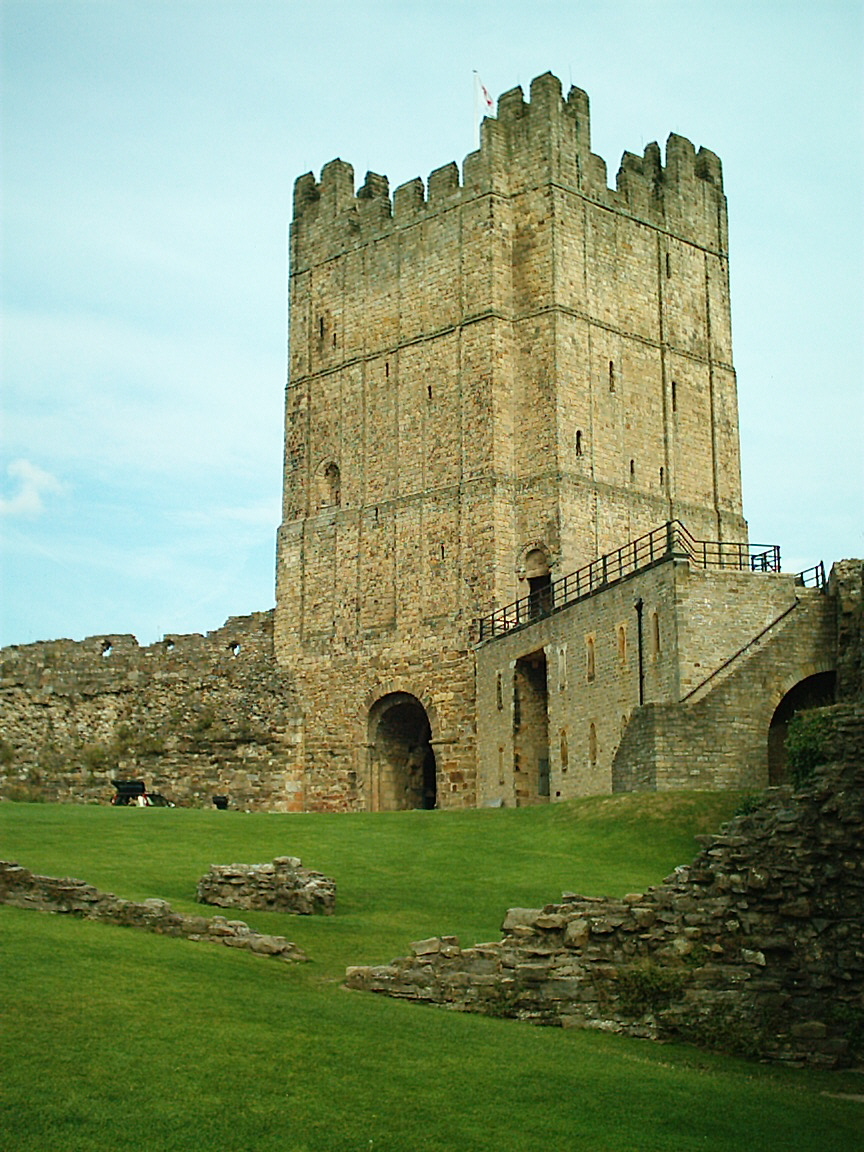
William granted G24 GF Alan Rufus vast acreage in the north, around York. Alan immediately set to work in 1070 building what would later be called Richmond Castle, to protect his Norman rule in the North against angry Anglo-Saxon subjects. The same modern genealogist quoted above writes,

Richmond Castle was constructed as an object of fear to overawe the Saxons and to serve as a stronghold against any future attempts at rebellion.

From the air, our “family castle” looked like this…


Richmond Castle


One website refers to G24 GF Alan Rufus as the “richest of the rich,” as a result of his brutal, confiscatory conquest. We have what may be a contemporary painting of him, sitting in his great hall with his lady, his officers and servants…


Alan Rufus the Red,

ruling from the Great Hall

in Richmond Castle, North Yorkshire


The castle tower and other portions of the structure are standing even today…


Richmond Castle today


The remains of the two story high great hall, where Alan Rufus feasted
The better of two extant accounts suggests that from Alan Rufus, the pedigree is as follow. Dates are frequently lacking in chronicles of the events listed, here. Dividing the years accounted for by the biographies listed below by the number of biographies generates an average generational span, from the birth of one generation to the birth of the next, of about 34 years.

The son of Alan Rufus, G23 GF Roaldus Musard de Richmond, probably born about 1064, shortly before the Norman invasion in 1066, is said to have lost lordship over Richmond Castle because, owing money to the king, he paid only 10 of 200 marks owed.

However, there is some evidence that the surrender of control may have been a voluntary arrangement to retire dept, or an afterthought amending a larger rearrangement of leadership to settle political debts while keeping the castle in the family -- the next Lord of Richmond was the brother of Alan Rufus, Alan Niger. Perhaps an additional reason was that G23 GF Roaldus Musard de Richmond was just too young at the time to rule such a rebellious land. Roaldus remained lord of appurtenant lands and evidently functioned as castle “constable,” the “XO” in charge of castle defense.

Around the time the First Crusade succeeded in seizing the Holy Land back from the Muslims, the wife of G23 GF Roaldus Musard de Richmond bore him G22 GF Hasculfus Musard de Richmond. At some point, probably before the year 1120 A.D., The role of that son as Constable was declared by the King to be an inheritable title, sio that he was formally appointed first Constable of Richmond Castle as well as Lord of Demesne, Keddington, Chilworth, Oxfordshire, Gloucestershire, and Stainbury.

Early in the 1100s, something happened to the weather in the world. Maybe there was a long lull in volcanic activity, resulting in a clearing of dust in the atmosphere. Maybe the Sun emerged briefly from one of the arms of the galaxy, decreasing dust and increasing visibility between the Sun and the planets. Whatever. Something caused the weather to get warmer. Crop yields in the “champion” country of central England began to boom. Food prices plummeted. Huge livestock concerns began to appear. Food aplenty resulted in a population explosion. An era of increased prosperity seems to have smothered rebelliousness and increased loyalty among the Norman Richmond’s Anglo-Saxon subjects.


Add Image

How the Dawson's and Eitelman's Are Descended from the Mayflower Pilgrims!

Years ago, when I started studying our family's genealogy, Grandmom -- mom's mom Anna M. Kearney -- told me, "Pete, look for the Sears genealogy! Look for the Sears genealogy!"

Well, I did, and I was amazed.

When I began to tell some of you, "Guess what! We're descended from not just one, but a few of the Mayflower Pilgrims!," you responded with that derisive grin which says, "Isn't that cute! He really believes that we're not descended from just pond-scum-sucking, trash-collecting low-lifes!"

Well, skeptics, here it is -- one of the lines from the Mayflower down to the present! Ha, ha, ha!

(1) The G-10 GPs of my generation, William MULLINS, later a Mayflower passenger, met and married Alice ATWOOD, later a Mayflower passenger, and gave birth to Priscilla MULLINS, later a Mayflower passenger.

(2) The G-9 GPs of my generation, Priscilla MULLINS, a Mayflower passenger, met and married John ALDEN, the cooper on the Mayflower, in Plymouth Colony, and gave birth to David ALDEN, of Plymouth Colony.

(3) The G-8 GPs of my generation, David ALDEN met and married Mary SOUTHWORTH, and gave birth to Alice ALDEN.

(4) The G-7 GPs of my generation, Alice ALDEN met and married Judah PADDOCK, and gave birth to Mary PADDOCK.

(5) The G-6 GPs of my generation, Mary PADDOCK met and married Judah SEARS, and gave birth to Alden SEARS.

(6) The G-5 GPs of my generation, Alden SEARS met and married Phebe WALKER, and gave birth to Edward SEARS. (There he is -- the man Uncle Eddie is named after -- NOT the doctor!!!)

(7) The G-4 GPs of my generation, Edward SEARS met and married Jemima ROOT, and gave birth to Philo SEARS.

(8) The G-3 GPs of my generation, Philo SEARS met and married Julia Anne CLINE, and gave birth to Susan E. SEARS.

(9) The G-2 GPs of my generation, Susan E. SEARS, after her first husband, Mr. Sorrell passed away, met and married Decatur PITMAN, and gave birth to May Katherine PITMAN.

(10) The Great Grandparents of my generation, May Katherine Pitman, met and married Michael George EITELMAN, and gave birth to Edward Decatur EITELMAN (named after his grandfather, NOT Stephen Decatur!!!)

(11) The Grandparents of my generation, Edward Decatur EITELMAN, met and married Anna M. KEARNEY, and gave birth to Eleanore Anne EITELMAN, and Uncle Mike and Uncle Eddie!

(12) My Parents Eleanore Anne EITELMAN met and married Edward J. DAWSON, and gave birth to humble Peter J. DAWSON and the rest of us!!!