Our lineal connection to Alan Rufus the Red -- our direct descendancy from him -- is one of the well-researched and legally-guarded genealogies of Western Europe. So, this is real. There is no exaggeration, here.
G24 GF Alan Rufus the Red, Count of Brittany, second cousin to William the Conqueror, was probably born around 1030 A.D. He accompanied William to Hastings in 1066 and commanded the Breton contingent there. In 1069-1070 Alan Rufus led an oppression of resistance in the North at William’s request. Our G24 GF was singularly brutal. Chronicler Simon of Durham wrote
“So great a famine prevailed that men, compelled by hunger, devoured human flesh, that of horses, dogs, cats…others, while about to go into exile, fell down in the middle of the journey and gave up the ghost. It was horrific to behold human corpses decaying in the houses, the streets and the roads: for no one was left to bury them in the earth…The stench was abominable and an extensive solitude prevailed all around. In the towns wild beasts were running in the streets.”
“So great a famine prevailed that men, compelled by hunger, devoured human flesh, that of horses, dogs, cats…others, while about to go into exile, fell down in the middle of the journey and gave up the ghost. It was horrific to behold human corpses decaying in the houses, the streets and the roads: for no one was left to bury them in the earth…The stench was abominable and an extensive solitude prevailed all around. In the towns wild beasts were running in the streets.”
A present-day genealogist gives a like assessment…
"[Alan Rufus] immediately established himself as absolute ruler and ruthlessly stamped out any pockets of Saxon resistance. The only diplomacy he understood was that of the sword. His methods, even by the standards of the time, were brutal and extreme. The Saxons were denied even elementary rights…"
William granted G24 GF Alan Rufus vast acreage in the north, around York. Alan immediately set to work in 1070 building what would later be called Richmond Castle, to protect his Norman rule in the North against angry Anglo-Saxon subjects. The same modern genealogist quoted above writes,
Richmond Castle was constructed as an object of fear to overawe the Saxons and to serve as a stronghold against any future attempts at rebellion.
From the air, our “family castle” looked like this…
William granted G24 GF Alan Rufus vast acreage in the north, around York. Alan immediately set to work in 1070 building what would later be called Richmond Castle, to protect his Norman rule in the North against angry Anglo-Saxon subjects. The same modern genealogist quoted above writes,
Richmond Castle was constructed as an object of fear to overawe the Saxons and to serve as a stronghold against any future attempts at rebellion.
From the air, our “family castle” looked like this…

Richmond Castle
One website refers to G24 GF Alan Rufus as the “richest of the rich,” as a result of his brutal, confiscatory conquest. We have what may be a contemporary painting of him, sitting in his great hall with his lady, his officers and servants…

Alan Rufus the Red,
ruling from the Great Hall
in Richmond Castle, North Yorkshire
The castle tower and other portions of the structure are standing even today…
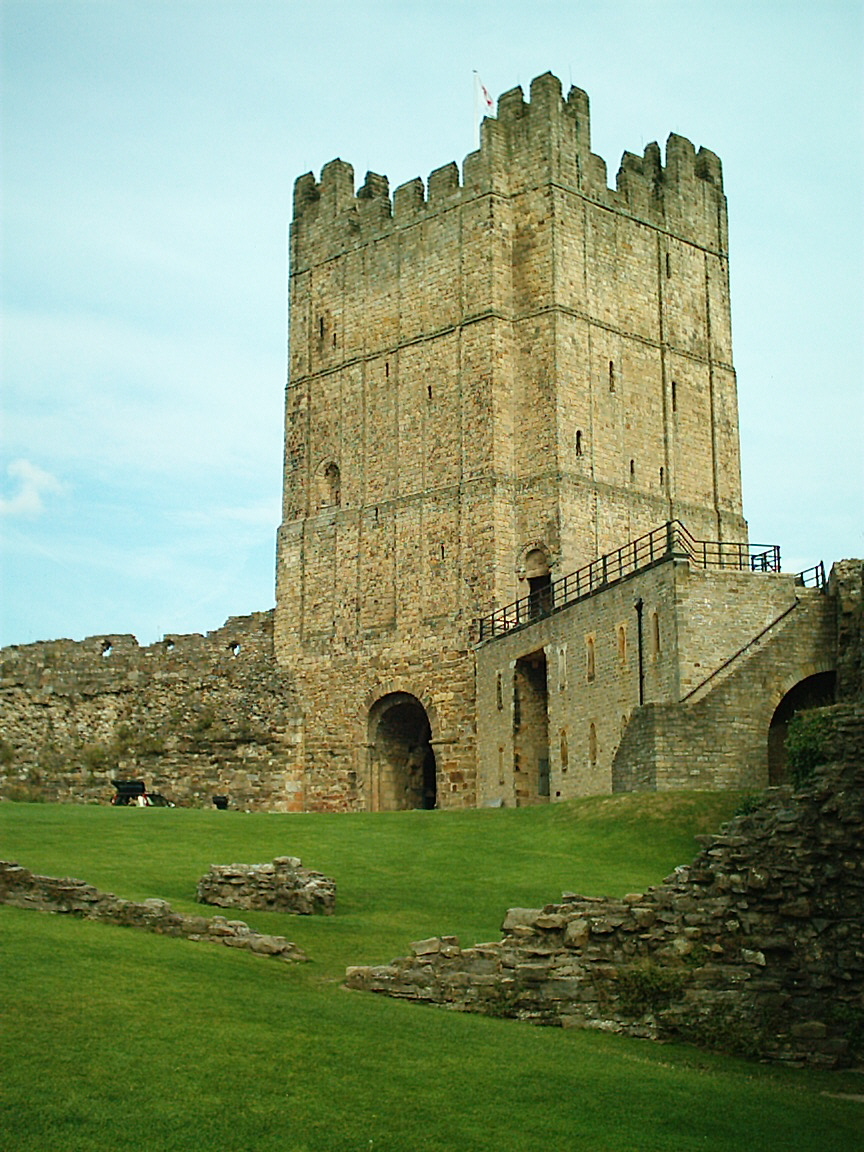
Richmond Castle today

The remains of the two story high great hall, where Alan Rufus feasted
The better of two extant accounts suggests that from Alan Rufus, the pedigree is as follow. Dates are frequently lacking in chronicles of the events listed, here. Dividing the years accounted for by the biographies listed below by the number of biographies generates an average generational span, from the birth of one generation to the birth of the next, of about 34 years.
The son of Alan Rufus, G23 GF Roaldus Musard de Richmond, probably born about 1064, shortly before the Norman invasion in 1066, is said to have lost lordship over Richmond Castle because, owing money to the king, he paid only 10 of 200 marks owed.
However, there is some evidence that the surrender of control may have been a voluntary arrangement to retire dept, or an afterthought amending a larger rearrangement of leadership to settle political debts while keeping the castle in the family -- the next Lord of Richmond was the brother of Alan Rufus, Alan Niger. Perhaps an additional reason was that G23 GF Roaldus Musard de Richmond was just too young at the time to rule such a rebellious land. Roaldus remained lord of appurtenant lands and evidently functioned as castle “constable,” the “XO” in charge of castle defense.
Around the time the First Crusade succeeded in seizing the Holy Land back from the Muslims, the wife of G23 GF Roaldus Musard de Richmond bore him G22 GF Hasculfus Musard de Richmond. At some point, probably before the year 1120 A.D., The role of that son as Constable was declared by the King to be an inheritable title, sio that he was formally appointed first Constable of Richmond Castle as well as Lord of Demesne, Keddington, Chilworth, Oxfordshire, Gloucestershire, and Stainbury.
Early in the 1100s, something happened to the weather in the world. Maybe there was a long lull in volcanic activity, resulting in a clearing of dust in the atmosphere. Maybe the Sun emerged briefly from one of the arms of the galaxy, decreasing dust and increasing visibility between the Sun and the planets. Whatever. Something caused the weather to get warmer. Crop yields in the “champion” country of central England began to boom. Food prices plummeted. Huge livestock concerns began to appear. Food aplenty resulted in a population explosion. An era of increased prosperity seems to have smothered rebelliousness and increased loyalty among the Norman Richmond’s Anglo-Saxon subjects.
The son of Alan Rufus, G23 GF Roaldus Musard de Richmond, probably born about 1064, shortly before the Norman invasion in 1066, is said to have lost lordship over Richmond Castle because, owing money to the king, he paid only 10 of 200 marks owed.
However, there is some evidence that the surrender of control may have been a voluntary arrangement to retire dept, or an afterthought amending a larger rearrangement of leadership to settle political debts while keeping the castle in the family -- the next Lord of Richmond was the brother of Alan Rufus, Alan Niger. Perhaps an additional reason was that G23 GF Roaldus Musard de Richmond was just too young at the time to rule such a rebellious land. Roaldus remained lord of appurtenant lands and evidently functioned as castle “constable,” the “XO” in charge of castle defense.
Around the time the First Crusade succeeded in seizing the Holy Land back from the Muslims, the wife of G23 GF Roaldus Musard de Richmond bore him G22 GF Hasculfus Musard de Richmond. At some point, probably before the year 1120 A.D., The role of that son as Constable was declared by the King to be an inheritable title, sio that he was formally appointed first Constable of Richmond Castle as well as Lord of Demesne, Keddington, Chilworth, Oxfordshire, Gloucestershire, and Stainbury.
Early in the 1100s, something happened to the weather in the world. Maybe there was a long lull in volcanic activity, resulting in a clearing of dust in the atmosphere. Maybe the Sun emerged briefly from one of the arms of the galaxy, decreasing dust and increasing visibility between the Sun and the planets. Whatever. Something caused the weather to get warmer. Crop yields in the “champion” country of central England began to boom. Food prices plummeted. Huge livestock concerns began to appear. Food aplenty resulted in a population explosion. An era of increased prosperity seems to have smothered rebelliousness and increased loyalty among the Norman Richmond’s Anglo-Saxon subjects.


.jpg)